
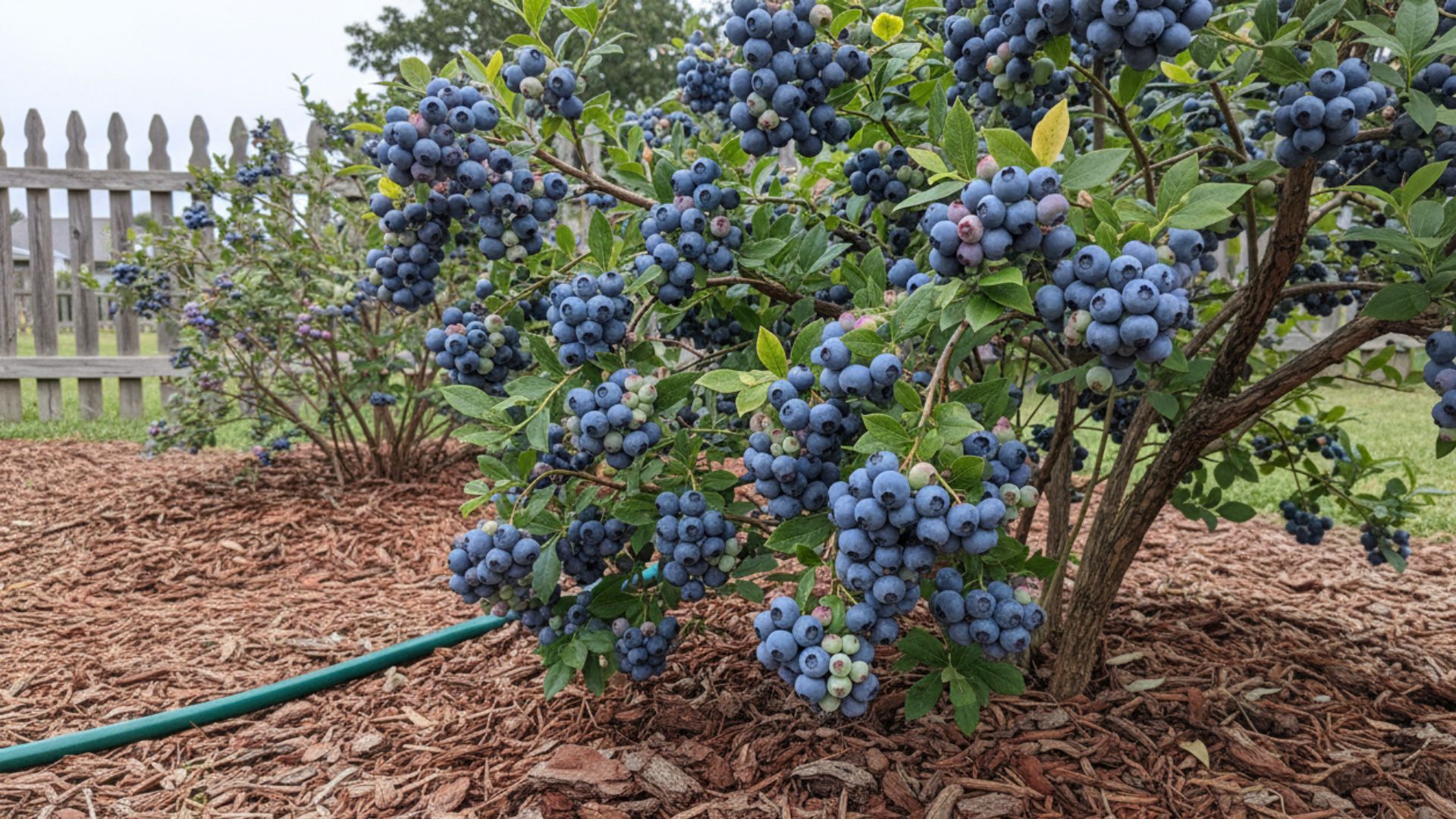
I killed three blueberry bushes before I figured out what I was doing wrong. Back in the early 1980s, I planted what I thought were perfectly healthy highbush blueberries along the south-facing fence in my Zone 5 garden in central Ohio. I watered them faithfully, fed them every spring, and waited. Year after year, the leaves went yellow, the plants barely grew, and the fruit — what little there was — tasted thin and disappointing. I finally brought a soil sample to my county extension office, and the agent looked at my results and said, “Margaret, your pH is 6.8. These blueberries are starving.” I had never even thought about pH. That conversation changed the way I garden. Let me walk you through everything I’ve learned in the decades since, so you don’t spend three years learning it the hard way.
The pH Secret: Why Most Blueberries Fail


Here is the honest truth about blueberries: soil pH is not one factor among many — it is the only factor that matters before anything else. Blueberries need a soil pH between 4.5 and 5.0. That is genuinely acidic, far more so than most garden vegetables, most fruit trees, and even most other berry crops. When the pH climbs above 5.5, the plants begin struggling to absorb iron and manganese from the soil even when those nutrients are physically present. Above 6.0, the leaves yellow in a condition called interveinal chlorosis, new growth stalls, and fruit production collapses almost entirely. The plants don’t die quickly — they linger, looking miserable, for years. That is exactly what happened to my first three bushes, and it is the story behind nearly every blueberry failure I’ve heard about over fifty years of talking with other gardeners.
The reason so many home gardeners miss this is that most garden soil across the Midwest and Northeast sits between pH 6.0 and 7.0 — perfectly fine for tomatoes and beans, but quietly lethal to blueberries. You cannot look at your soil and guess the pH. It has no smell, no color, no texture that gives it away. The only way to know is to test, and I would not skip that step for anything in the world.
Best Highbush Varieties for Zone 5
Once I sorted out my soil, I started paying much closer attention to variety selection. Not all highbush blueberries perform equally in Zone 5 winters, and the differences matter a great deal when February sends temperatures down to minus ten degrees Fahrenheit for a week straight. Over the years I’ve grown and observed several varieties, and I have definite favorites.
Bluecrop
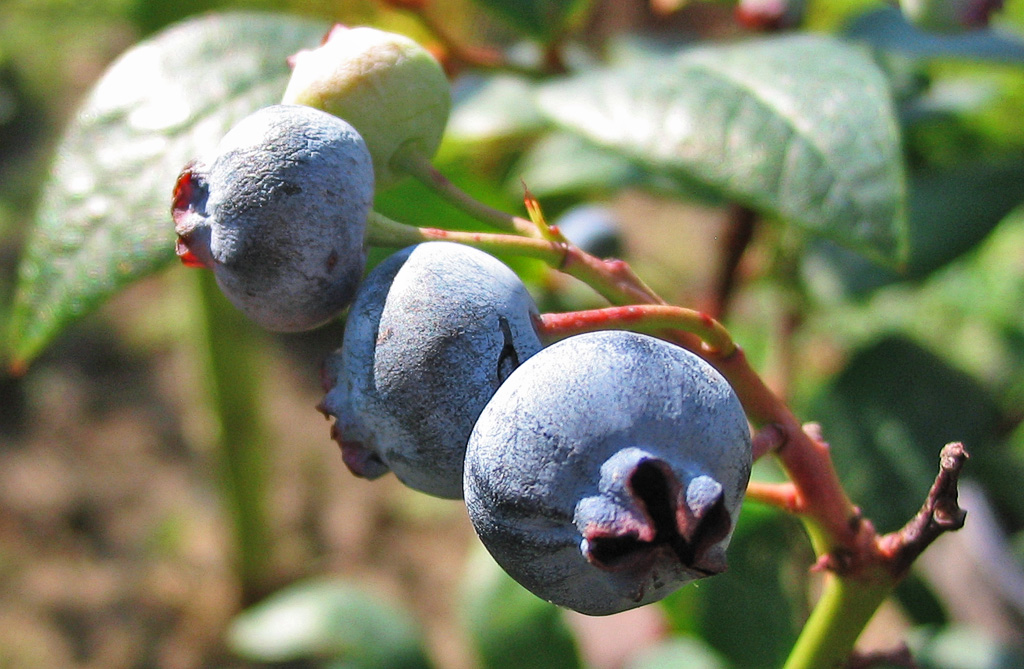
Bluecrop is the variety I recommend first to anyone gardening in Zone 5, and it has been that way since I planted my first one in 1987. It is the most widely grown highbush blueberry in the country for good reason: it is reliable to the point of stubbornness. At maturity it reaches 4 to 6 feet tall and equally wide, with a tidy upright form that looks intentional even in a home garden. The berries ripen in mid-season — roughly mid-July in central Ohio — and they hold on the bush for two to three weeks without softening, which gives you a long picking window. I’ve walked out to pick Bluecrop after a week of being busy elsewhere and still found firm, flavorful fruit waiting. The flavor is classic blueberry: sweet with just enough tartness to have character. In Zone 5 winters it has never suffered significant dieback for me, even after stretches of minus-twelve-degree weather.
Patriot
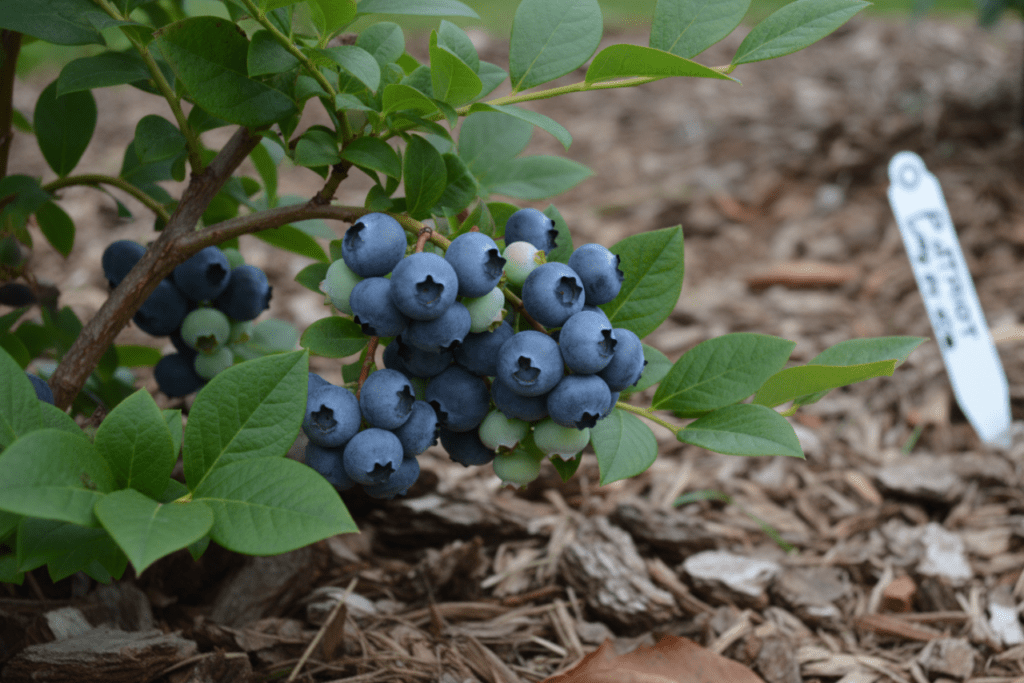
Patriot is my second essential recommendation for Zone 5, and it has a particular advantage: it ripens about ten days earlier than Bluecrop, extending your harvest season in the most pleasant possible direction. At 3 to 4 feet tall it is more compact than Bluecrop, which makes it a good fit for smaller yards or for tucking into a mixed border. It is rated hardy to Zone 3, meaning it handles cold with a confidence that takes the worry out of late springs and early falls. The berries are large, firm, and wonderfully flavored, and I’ve found Patriot to be more tolerant of heavier, wetter soils than most other highbush varieties — though I still amend for drainage, always. I planted two Patriot bushes alongside three Bluecrop plants, and that combination has given me fresh blueberries from early July through the first week of August most years.
Other Strong Performers for Zone 5
Beyond Bluecrop and Patriot, there are several other varieties worth knowing. Blueray produces very large, sweet berries and is similarly cold-hardy, though I find it a touch more sensitive to drought stress than Bluecrop during hot July stretches. Northland is a semi-highbush type that stays compact at around 4 feet, spreads vigorously, and handles wet clay soils better than most — a genuine asset in parts of the Midwest. Jersey is a late-season variety that ripens in August when most other bushes are winding down, making it a smart addition if you want to stretch the harvest into late summer. Any combination of two or more of these varieties will give you better fruit set than planting any single variety alone, because blueberries — while technically capable of some self-pollination — produce heavier crops with more consistent berry size when cross-pollinated by a nearby companion variety.
Preparing Your Blueberry Bed: Getting the pH Right
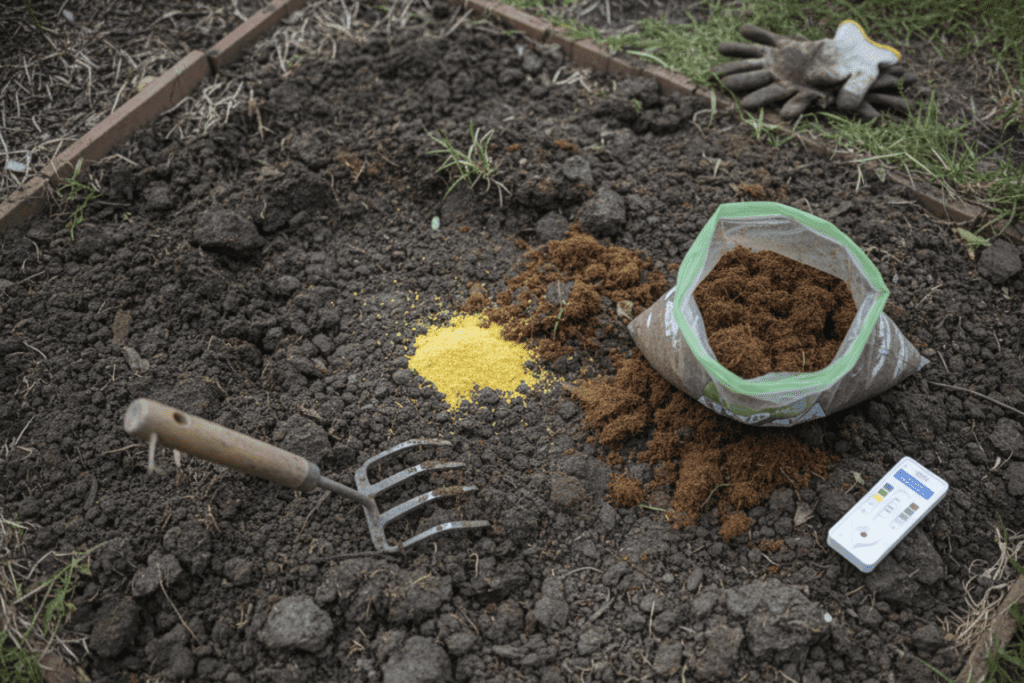
Before you buy a single plant, before you dig a single hole, get your soil tested. I cannot say this firmly enough. A basic soil test costs between fifteen and twenty dollars through most county extension offices, and it will tell you your current pH, your nutrient levels, and often exactly how much amendment you need to apply to reach your target. That fifteen-dollar test has saved me more money and frustration over the years than I could possibly calculate. You can also buy a simple home pH meter for around twenty to thirty dollars at a garden center — they are not as precise as a lab test, but they will tell you whether you’re in the right general range.
If your soil pH is above 5.0 — which it almost certainly will be if you haven’t specifically grown acid-loving plants there before — you will need to lower it with granular sulfur. The standard rate is approximately 1 pound of elemental sulfur per 100 square feet to lower pH by roughly one unit. So if your soil tests at 6.5 and you need to reach 4.8, you are looking at somewhere between 1.5 and 2 pounds per 100 square feet, worked in as a starting dose with a follow-up test in three to four months. I work sulfur and peat moss together into the planting bed to a depth of 8 to 10 inches — the peat helps acidify and also improves drainage and aeration in heavy soils. Avoid lime in any form anywhere near your blueberry bed; lime raises pH and will undo everything you’ve worked toward. Give your amended bed three to six months before planting so the sulfur has time to react with the soil and stabilize the pH. Patience here pays off significantly.
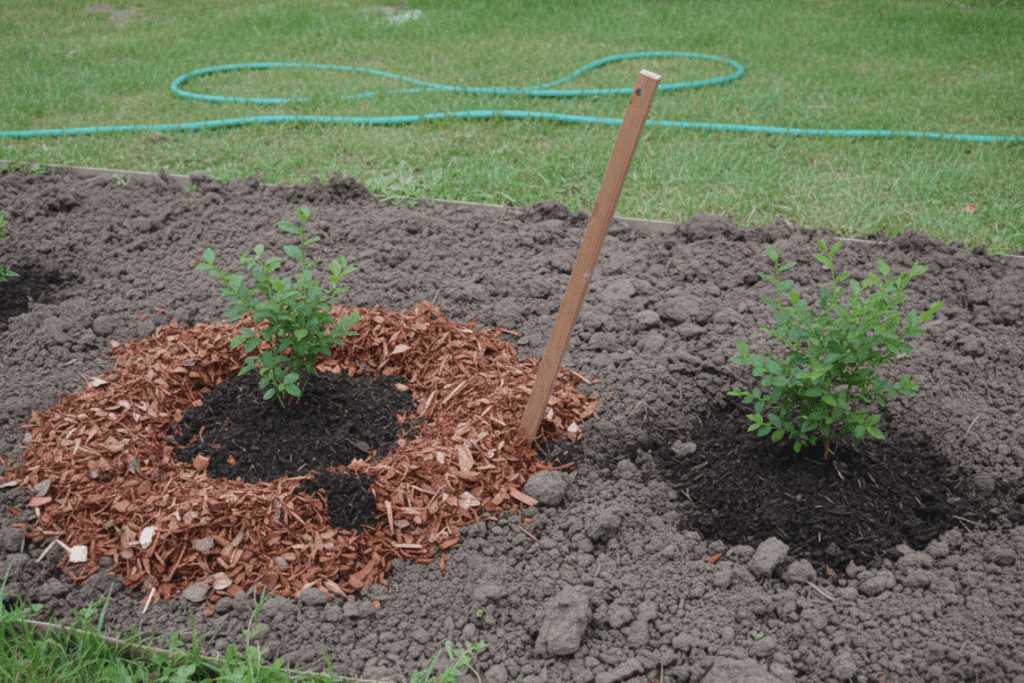
Once the bed is ready and the plants are in, lay down 3 to 4 inches of pine bark mulch or wood chips across the entire planting area, keeping the mulch pulled back an inch or so from the crown of each plant. This mulch layer does three things simultaneously: it conserves moisture during dry spells, it suppresses weeds that would otherwise compete with your shallow-rooted blueberry plants, and it very gradually acidifies the soil as it breaks down over the years. Pine bark is my preferred choice because it breaks down slowly and acidifies more reliably than plain wood chips, but either will serve you well. I refresh my mulch layer every two to three years to maintain that 3-to-4-inch depth.
Planting and the First Three Years
The best time to plant highbush blueberries in Zone 5 is spring, as soon as the soil is workable and the worst frost danger has passed — typically April through mid-May in most parts of the zone. Fall planting is possible but riskier; young plants don’t always have time to establish sufficient root systems before the ground freezes. I’ve planted blueberries in both seasons and strongly prefer spring for the security it gives.
Space your plants 4 to 5 feet apart within a row, and if you’re planting multiple rows, leave 8 to 10 feet between rows so you have comfortable access for harvesting and pruning as the bushes mature. This spacing looks generous when you’re planting small 1-gallon or 2-gallon nursery starts, but within four or five years you will appreciate every inch of that room. Plant two to four different varieties in any given bed for cross-pollination. In my experience, gardens with mixed varieties consistently out-produce single-variety plantings in both total berry count and individual berry size.
Here is the hardest advice I give, and the most important: in the first year after planting, remove every single flower bud the moment you see it. I know how painful that sounds. You want berries — that’s why you planted blueberries. But those first-year flowers, if allowed to develop into fruit, divert energy away from root development at the exact moment when strong roots matter most. A plant that establishes a deep, wide root system in year one will out-produce a plant that fruited weakly in year one for the entire rest of its twenty-plus-year life. I remove flowers in year one every single time, without exception, and I’ve never once regretted it.
For fertilizing in that critical first year, use an acidic fertilizer formulated for azaleas or blueberries — never a general-purpose garden fertilizer, which will damage blueberry roots at high rates and may push your pH in the wrong direction. Apply no more than 1 ounce of fertilizer per plant at bloom time, then repeat that same 1-ounce dose approximately one month later. That is the full fertilizer program for year one. More is not better with blueberries; salt burn from overfertilizing is a real and common problem, especially with young plants.
Feeding and Long-Term Care
Once your blueberries are established — meaning year two onward — the fertilizer program expands slightly but the principle stays the same: acid-forming fertilizers only, applied at moderate rates, twice per season. I use ammonium sulfate, which is inexpensive, widely available, and does double duty by supplying nitrogen while gently acidifying the soil with each application. Blueberry-specific granular fertilizers marketed under brand names also work well and are worth using if you prefer not to measure ammonium sulfate by the ounce. Apply the first dose when flower buds begin to swell in early spring, and the second dose about four to six weeks later. Stop all fertilizing by early July; late-season nitrogen pushes tender new growth that won’t harden off properly before frost.
Beyond fertilizing, plan to retest your soil pH every two years and apply additional granular sulfur as needed to keep it in that 4.5-to-5.0 window. Even with pine bark mulch doing slow acidifying work, soil pH can creep upward over time, especially in areas with alkaline irrigation water or naturally buffered subsoil. A quick pH test every other fall takes five minutes and ensures you catch any drift before it affects your plants.
As for when to expect real harvests: I will not mislead you with false optimism. You will get a small number of berries in year two, enough to taste what’s coming. A genuinely meaningful harvest — the kind worth preserving or sharing with neighbors — arrives in years three and four. Full production, where a mature bush yields 5 to 10 pounds of berries per season depending on the variety and conditions, comes in years six through eight. Blueberries are a long game. But once they are established in properly acidified soil, they are among the most low-maintenance and long-lived fruit plants you can grow. I have bushes in my garden that are over thirty years old and still producing beautifully every summer.
Quick-Fire FAQ
**Q: How can I test my soil pH at home without sending it to a lab?**
**A: Use a digital pH meter (around $20–30) pushed into moist soil at several spots, or a chemical indicator strip kit for about $10. For the most accurate baseline before planting, an extension office test is worth the small cost.**
**Q: Will a single blueberry plant produce fruit?**
**A: A single highbush plant will produce some fruit, but yield is dramatically better with a second variety planted 5 to 8 feet away for cross-pollination. Plant at least two varieties and you can easily triple your harvest.**
**Q: How long will I wait before my first real harvest?**
**A: Expect a small taste in year two and a harvest worth celebrating in years three and four. Full production — 5 to 10 pounds per bush — arrives in years six through eight.**
**Q: Will coffee grounds lower my soil pH and help my blueberries?**
**A: Used coffee grounds are nearly pH neutral and will not meaningfully lower soil pH — that is a persistent myth. For real pH adjustment, rely on a soil test and elemental sulfur.**
— Grandma Maggie